Doolan Larson Building
“UNFOLDING A LIVING LANDMARK”
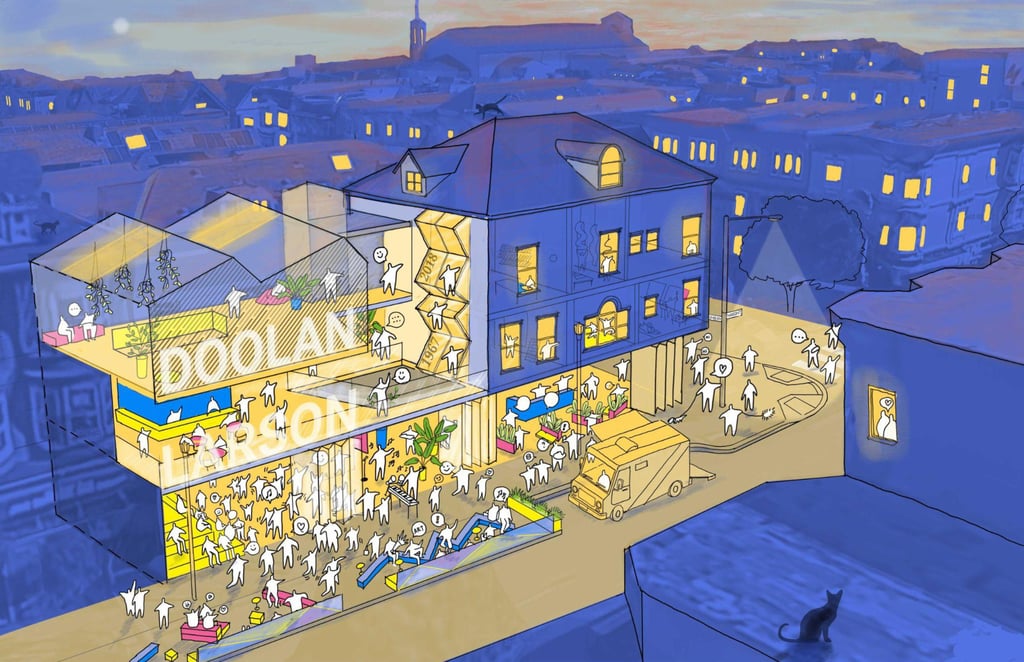
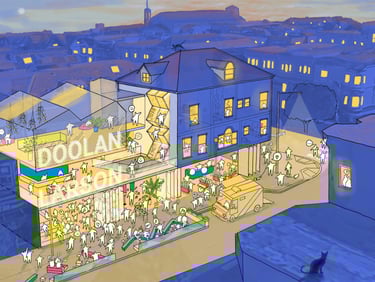
Our concept reimagines the Doolan-Larson House as a living cultural anchor, transforming a once-sealed historic residence into an open, creative, and community-facing public house. Rather than preserving the building as a static artifact, the design unfolds its history, its street edge, and its program — allowing past and present to coexist in a bold architectural dialogue.
Location: San Francisco, CA
Size: 12,500 SF
Type: Architecture + Landscape
Status: Conceptual design
Team: April Liu (Landscape Architect),Jen Xu (Architect), Anqi Zhao (Designer), Ruochen Wang (Artist)


1. Unfold the History
The corner of Haight and Ashbury has long been hailed as a cultural anchor of the Counterculture era. Since 1967, countless visitors have flocked here for a photograph beneath the iconic street signs — often unaware of the building that has framed every image. The Doolan-Larson Building, steadfast in the background, has witnessed a full century of prosperity, decline, reinvention, and return.
By tracing the building’s timeline alongside the evolution of the Haight-Ashbury neighborhood and San Francisco’s shifting cultural identity, we reveal moments when the house, the district, and the city’s artistic spirit converged into a single cultural force. Less visible, yet equally meaningful, is how this mixed-use building embodied the neighborhood’s transformation: from streetcar suburb to urban crossroads, from upper-class residence to communal refuge, from order to the joyful embrace of disorder. If the Summer of Love is history, then the Doolan-Larson Building is the incubator that helped shape it.
To pull forward the threads often hidden behind the familiar façade, we envision this building not only as an architectural landmark, but as a living room for the city — a place for gathering, making, performing, and creating. A platform for new bonds, a stage for emerging voices, a canvas for artists yet to come. In doing so, it can once again become a living cultural incubator, not a frozen artifact, continuing the lineage of creativity that has always defined this corner.


2. Unfold the Street front
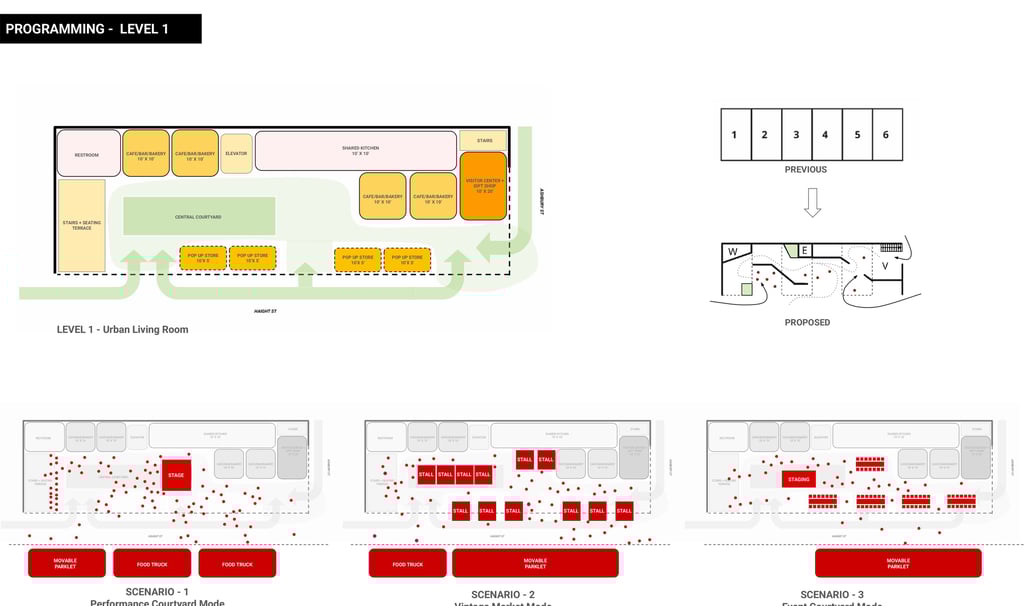
By unfolding the Level 1 façade, the design opens the space to the public and draws people in through active programs, curated activities, seating terraces and unexpected open-to-sky courtyards. The former six individual retail shops are transformed into a flexible “urban living room” that can host a wide range of uses.
Flexible, moveable walls can accommodate multiple scenarios—from concerts and performances to vintage markets and event space. The activation of the street level extends beyond the building itself to include the sidewalk and even the adjacent parking lot, with potential for parklets and food trucks.
At the same time, smaller shops, cafés, pop-up stores, and rentable event spaces remain available to support ongoing financial benefits. Together, these elements create a new mixed-use corner that is open, public-facing, and active from morning to night—a street-connected cultural threshold.
3. Unfold the Community
Understanding user needs is key to guiding this building’s transition from a historic residence into a public creative incubator. Our design approach begins with analyzing potential user personas and shaping spaces that genuinely respond to their needs. User personas—visitor, neighbor, and artist—are treated as real design inputs, not fiction. Each has a distinct path through the building, moving between past and present, public and private, everyday life and art.
The visitor discovers the house, takes photos, learns its history, and then returns for an immersive show.
The neighbor uses the “urban living room” as a community hub, and returns to the creative commons for personal interests or art exploration.
The artist meets the public directly, using the house as both studio and gallery.




DESIGN STRATEGY: ARCHITECTURAL EXPRESSION & SPATIAL FRAMEWORK
Aesthetic Direction: “Then & Now”
The relationship between old and new is deliberate: the historic form remains proud and intact, while the new volumes are bold, forward-looking, and distinctly of this era—a dialogue rather than competition.
Historic Fabric
Restore wood detailing, windows, and recognizable silhouettes.
Maintain the recognizable presence of the original house.
New Insertions
Open stairs and terraces that act like outdoor porches。.
Metal frames and glass that signal contemporary additions.
Spatial Framework
The building operates as a vertical cultural ecosystem—a stacked sequence of public, semi-public, and private space for creatives.




LEVEL 1 — PUBLIC THRESHOLD + CULTURAL GROUND
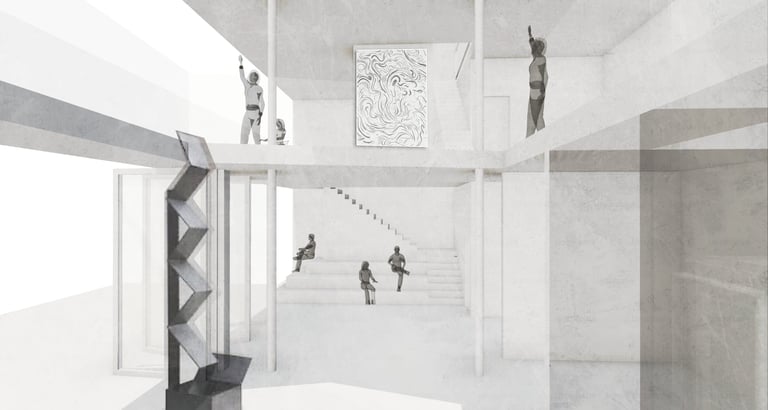
Level 1 becomes the Urban Living Room, a porous and fully openable ground plane that reconnects the Doolan-Larson House to the street. A series of folding storefronts creates seamless indoor–outdoor movement, supporting visitor entry, micro-retail, and daily community flow. At the center, the Light Court anchors the entire building, acting as a flexible stage, gathering space, and vertical source of daylight. The Social Stair, with its terraced seating, amplifies this dynamism and allows performances, casual gathering, or simply a moment to pause.
LEVEL 2 — ART TERRACE + COMMUNITY CONNECTION
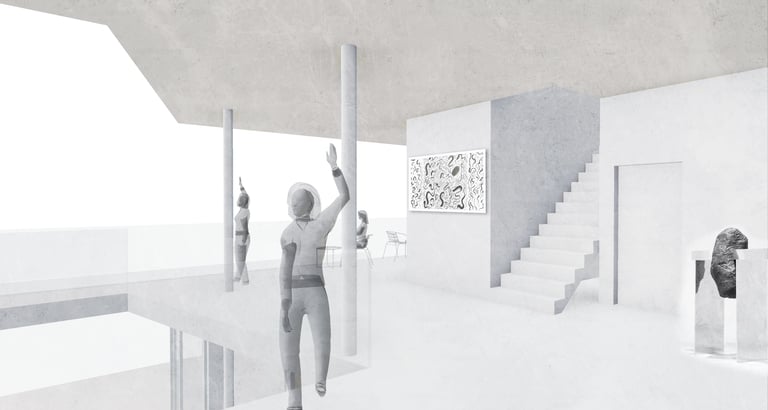
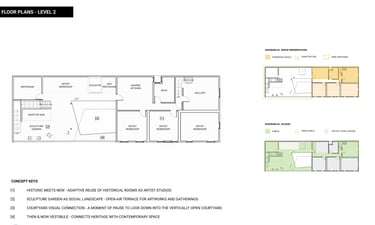
Level 2 is defined by the Then & Now Vestibule—a horizontal connector bridging the historic structure to the new addition. This movement sequence opens into the Sculpture Garden, an outdoor terrace for exhibitions, informal gatherings, artist showcases, and rooftop social life. The Horizon Bar strengthens this activation, supporting community events and daily use. Existing rooms are Reimagined as artist workshops, tying creative production directly to public-facing areas. Overlooks into the courtyard maintain a visual and spatial link to Level 1, establishing the building as a layered public environment.
LEVEL 3 — CREATIVE COMMONS + VERTICAL CONNECTIVITY
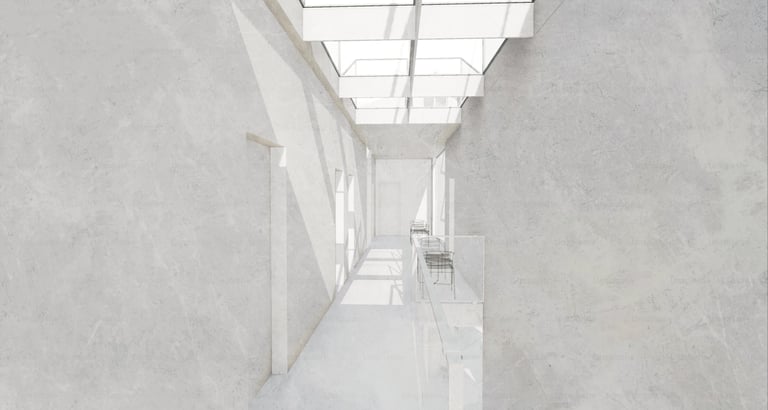
Level 3 becomes the Creative Commons — The Maker’s Floor, where flexible classrooms, studios, and community-facing programs support education and cultural production. The level is animated by Craft Frames, diamond-shaped or fold-open windows that reveal glimpses into artists’ studios and preserve sightlines into the historic structure. A continuous Skywell pulls daylight through the building’s center, establishing a vertical view corridor down to the courtyard. This three-level connectivity brings cohesion to the entire cultural ecosystem, supporting day-to-night programming and cross-disciplinary collaboration.
Views